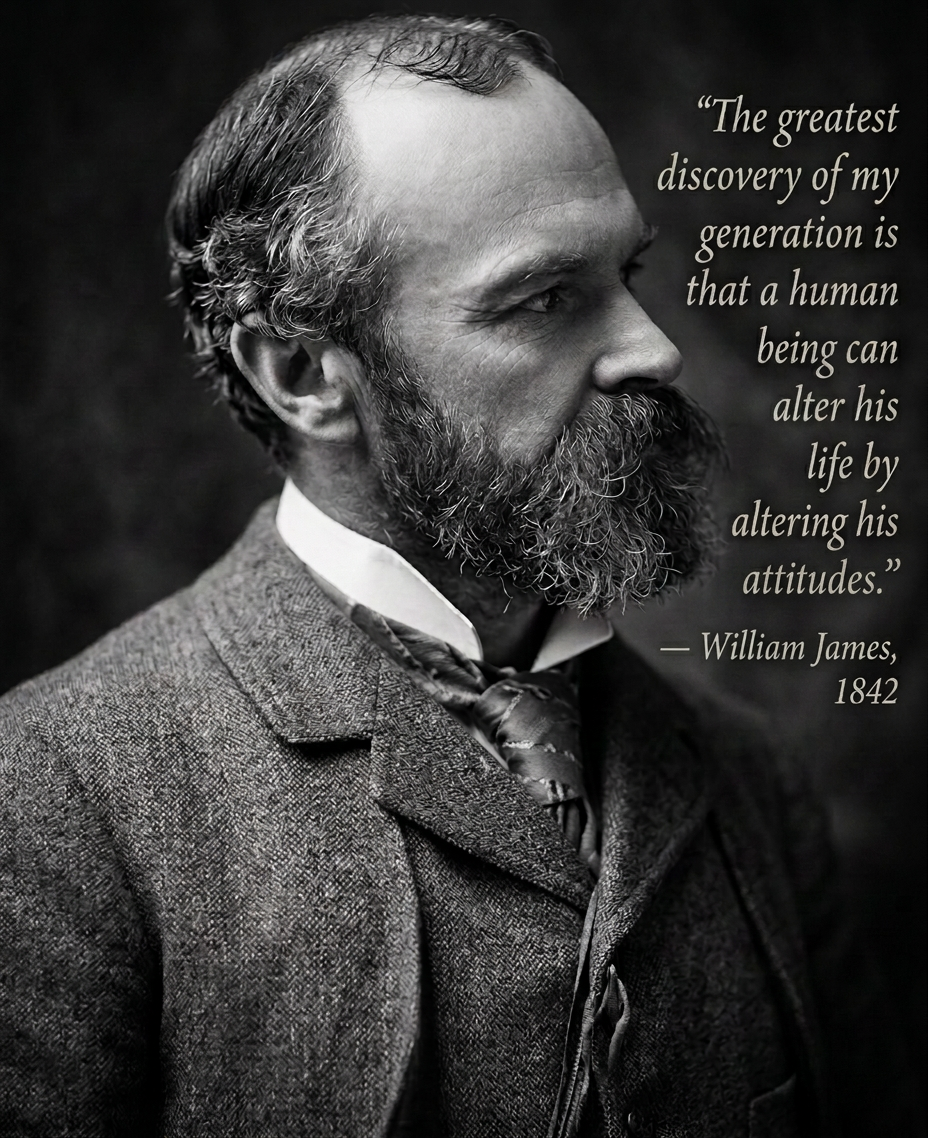
William James:
A revolutionary thinker and his timeless insights.
Sonia Valente 13/10/2026
What if the mind were not simply a thinking machine, but a compass guiding us through the maze of life?
More than a century ago, William James, one of the most fascinating and revolutionary figures in psychology, asked this exact question. Born in 1842 in New York City into a vibrant intellectual family (his brother was the celebrated novelist Henry James), William initially studied medicine. However, he soon abandoned it to pursue a singular, grand passion: understanding how human beings think, feel, and experience the world (Benjamin, 2014). The culmination of this journey was his landmark book, The Principles of Psychology (1890), a masterpiece that changed the rules of the game forever (James, 1890).
Driven by Darwin’s theory of evolution, James was not interested in merely mapping the anatomy of the mind; he wanted to know what the mind was used for. This approach laid the foundation for functionalism, a school of thought examining how mental processes function and help individuals adapt to their surroundings (OpenStax, 2020). James firmly believed that understanding the mind meant asking not only what it does, but why it matters to our daily survival (Benjamin, 2014).
To explain this dynamic relationship between humans and their environment, James introduced three core pillars that sill define our everyday psychology:
The stream of consciousness:
James famously described our awareness not as a collection of disjointed pieces, but as a continuous, ever-changing river. Thoughts, feelings, and memories naturally flow into one another, constantly shaped and filtered by our selective attention (James, 1890).
The James-Lange theory of emotion:
We usually assume that we cry because we are sad or run because we are afraid. James completely flipped this logic. He proposes that bodily reactions come first, and emotion follows (James, 1884). Hearing footsteps on a dark street triggers a racing heart; it is our perception of these physical changes that creates the feeling of fear.
The power of habit
If consciousness is a river, habits are the channels that direct its flow. James emphasised how repetition turns effortful actions, like learning to play the piano, into effortless, automatic behaviour. Habits conserve vital mental energy but can also make unwanted behaviours hard to change. His insights remain relevant to discussions on learning and behaviour change (James, 1890).
This obsession with practical utility eventually led James beyond the boundaries of psychology and into philosophy, where he became a leading advocate for pragmatism (James, 1907). Rather than judging beliefs and ideas by abstract or purely theoretical standards, pragmatism evaluates them based on their real-world consequences. To James, an idea is only as valuable as its capacity to help us navigate, understand and improve our daily lives.
Ultimately, the enduring legacy of William James does not lie in a rigid set of dogmatic answers, but in his unique way of asking questions. He successfully connected the biology of the body with the poetry of the inner life, transforming psychology into a deeply human science. Yet what happens when the forces shaping our behaviour operate entirely outside of this conscious stream? That very question soon inspired another influential and controversial giant, Sigmund Freud, to turn his attention to the uncharted depths of the unconscious mind.
Word count: 539
References
Benjamin, L. T., Jr. (2014). A brief history of modern psychology (2nd ed.). Wiley-Blackwell.
James, W. (1884). What is an emotion? Mind, 9(34), pp. 188–205, available at: https://doi.org/10.1093/mind/os-IX.34.188
James, W. (1907). Pragmatism: A New Name for Some Old Ways of Thinking. New York: Longmans, Green and Co. https://doi.org/10.1037/10851-000
James, W. (1918). The Principles of Psychology. (Vols. 1-2). New York: Henry Holt and Company
OpenStax (2020). “1.2 History of psychology,” in Psychology 2e. Available at: https://openstax.org/books/psychology-2e/pages/1-2-history-of-psychology (Accessed: 10 October 2026).